Finding a Voice Without Asking Permission
Inside the world of Fiona Rose

There is a moment many designers reach where the question stops being what do I want to make and becomes how much of myself am I willing to protect while making it.
For Fiona Rose, that question was never abstract.
From the beginning, she knew she did not want to work within someone else’s vision. Not because she rejected collaboration, but because authorship mattered. Her brand was not a stepping stone or a compromise. It was the clearest way she knew how to express her own design language, on her own terms.
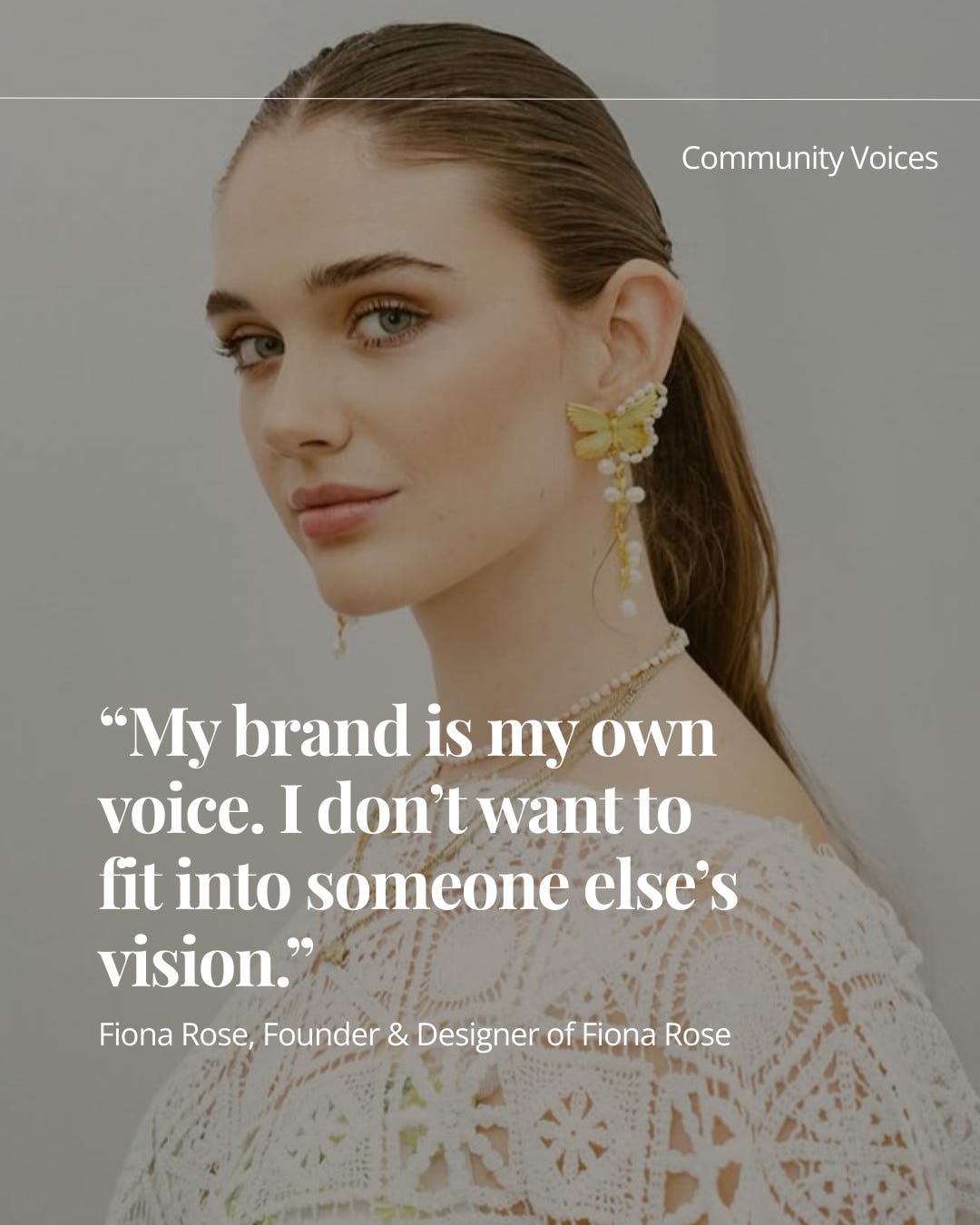
“My brand is my own voice,” she says plainly. The statement is less about independence as rebellion and more about clarity. Fiona was not interested in adapting her ideas to fit an existing framework. She wanted to build one.
Designing as self definition
The most personal part of Fiona’s process happens early, long before a garment is finished.
Research and design are where she works through thought. How ideas take shape. How color, form, and construction translate what she is feeling and seeing into something tangible. This stage is both the most fulfilling and the most demanding. Inspiration, for her, is deeply individual. When it arrives, it is unmistakable. Before it does, the search can be stressful, internal, and consuming.
That tension is part of what gives her work its character. Fiona’s designs are intentional because they are not rushed into clarity. They are allowed to emerge.
Once production begins, the process becomes more technical. Decisions around construction, simplification, and execution follow. But the foundation is always set in those early, exploratory moments where her thinking is most visible and most her own.
Independence, with consequences
Building independently creates freedom, but it also concentrates responsibility.
Fiona currently makes all of her garments herself. She does not work with factories yet. Every piece carries the weight of her time, labor, and attention. In that context, it is easy to lose sight of one’s own value, especially when the brand is not yet paying its founder.
“All the money goes right back into Fiona Rose,” she explains. The trade off is common among early stage designers. The work continues because it has to, even when compensation does not.
This experience has deepened her respect for craftsmanship across the industry. It has also reshaped how she understands pricing, value, and what luxury actually represents. Perfection, she believes, takes time. And time is the invisible cost behind every well made garment.
New York as pressure and possibility
Being based in New York intensifies everything.
The city is fast, competitive, expensive, and often guarded. Gatekeeping is real. So are the long days and the doubt that comes with them. But New York is also infrastructure. Access. Density. It is the garment district, the fabric stores, the specialty services, the chance discovery that comes from wandering into a storefront without knowing what you will find.
For Fiona, New York is both pressure and opportunity. The difficulty is undeniable, but so is the possibility. “You have everything you would ever need to succeed here,” she says. The city has shaped her expectations and expanded her understanding of what the industry holds.
She would not trade that experience, even on the hardest nights.
What clothing gives back
Seeing her designs worn by real women has been one of the most grounding parts of building the brand.
The late nights, the stress, the mistakes, all recede in those moments. What remains is the transformation that happens when a garment fits properly and reflects something true about the person wearing it.
Fiona’s work is rooted in the belief that clothing can change how someone feels about themselves. Her designs use color and form deliberately, pushing back against the visual conformity that often defines adulthood. Color, she notes, is expressive and risky. It asks to be seen.
Her goal is simple but ambitious. To create garments that allow women to feel more like themselves. To never have a bad day because of an outfit. To stand out not through excess, but through intention and fit.
The cost of commitment
Protecting a creative voice in fashion is not passive. It requires focus and sacrifice.
Fiona is unapologetic about how much of her life currently revolves around her brand. She works a day job as an assistant designer, then walks to her studio and continues working until it is time to sleep. Hustle culture is not something she romanticizes, but she is realistic about what it takes to build something meaningful.
Success, in her view, requires time and effort. There are no shortcuts. The process itself becomes a way of discovering identity as a designer, not just producing collections.
What she underestimated most was not the work, but the challenge of connecting with her audience. Learning how to reach the women her designs are for remains one of the hardest parts of building the brand.
Why this perspective matters
Fiona Rose’s story is not about speed or scale. It is about authorship.
In an industry that often pressures young designers to adapt, simplify, or dilute their point of view, her commitment to building without compromise stands out. Not as defiance, but as clarity.
Fashion does not move forward because everyone fits in. It moves forward when designers insist on their own visual language and give it the space to mature.
Fiona is doing exactly that. One garment at a time.